Baroque Explorations

Baroque Explorations

Notes on the Writing Life

Wednesday, April 28, 2010

Standing (dangerously) tall—the Bata exhibit

.
While in Toronto, I finally went to the Bata museum, thanks to a note from writer Susan Holloway Scott about a special exhibit: "On a Pedestal: From Renaissance Chopines to Baroque Heels."

What took me so long? This is a wonderful museum—and this exhibit was fantastic. I had no idea!

While there, I bought the book by curator Elizabeth Semmelhack about the exhibit — it's full of historical detail.

I took a pile of notes. Here are some of the things that struck me.


Slap-soled shoes (shown at left): so named because they make a slapping sound (although I don't quite get that). The flat base was created to keep pointed heels from sinking into the mud.

The more impractical something was, the higher the class: for example, shoes of white kid were fashionable because they were so easily soiled they implied a life of leisure.

Chopines (as seen on the book cover above, and which could rise to truly dangerous heights) signified wealth because of the added cost of the expensive material required for the gown to reach the floor. They were especially popular in Spain and Italy, where they were worn by wealthy married women.

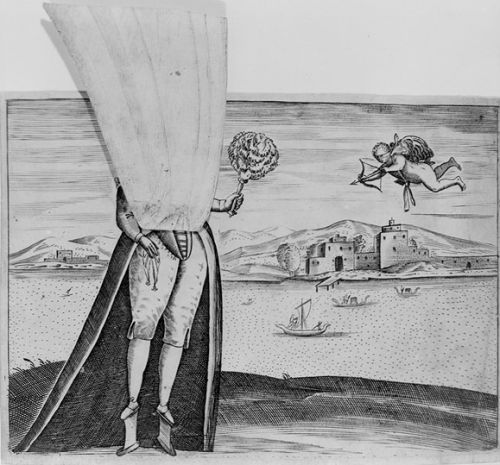
Curiously, at an earlier period in Italy, law required that prostitutes wear chopines. This Bertelli print of about 1588 shows a "cortesan." A flap comes up to reveal her pantalons and chopines. (I was surprised to see pantalons at all: generally, women wore nothing under their skirts.)

The late 17th century saw a shift toward lower heels. In France, low-platform mules were worn by both men and women "around the house" (read: castle).

The mules for women were little jewels, gorgeously embroidered and embellished, with pointed toes and slender heels.

I appreciated seeing the famed red-painted heels of the aristocratic male of that period. It's likely that the paint has faded, but the color looks more like a rich mahogany stain applied to the stacked leather heels. Men's wear tended to have an equestrian function: sturdy, heeled, with broad square toes.

The Sun King, of course — who was passionate about shoes, among other things — wore pretty mules with bright red heels.

For more on this wonderful exhibit, see these links: 


Tumblr: http://sandragulland.tumblr.com/

Tuesday, April 13, 2010

Baroque dance!

.
Curious to know what a baroque dance might be? This is an excellent video of three:

Saturday, April 10, 2010

The high cost of sin (in 17th century France)

.
From a book review of After Lives: A Guide to Heaven, Hell and Purgatory by Paul Johnson:
Writing on purgatory, Casey cannot resist quoting tariffs for indulgences. He has found a French document of 1691 that provides a curious insight into the relative seriousness of sins. A dispensation buying absolution from apostasy was the equivalent of only £4. Dispensation from vows of chastity was £15. Murder was priced at £95. The most expensive was bigamy, £1051. What does this tell us about the France of Louis XIV?
 Indeed!

Friday, April 9, 2010

Hard on nursemaids: more on the Sun King's voracious hunger

.
This is a beautiful blog post on the life of Louis XIV. (Note my cautions below, however.)

The images are striking. I like the painting at left especially: 


Dame Longuet may have been Louis's first nursemaid, but she certainly was not his last. He was born with two teeth, and eight more women tried to fulfill the role, but resigned in defeat. (Observing the future King's ferocious appetite, the Swedish ambassador advised the neighbors of France to "take precautions.")

Finally, robust Pierrette Dufour persisted. She became the King's nurse when he was six months old and she nursed him for eighteen months, suffering many bites, which she is said to have healed with the finger of Saint Anne. (The real finger?!) In recognition of her "good milk," she was ennobled in 1563. She later became maid to the Queen Mother, Anne of Austria, and then the Queen, Marie-Thérèse. It was Pierrette Dufour who had the honor of ceremoniously waking the King with a kiss each morning, and even going with him on campaigns. 

Note that the baby is swaddled according to 17th century custom. It was believed that the child would thus grow straight and would not remain curved like an animal. Baby Louis wears the cordon bleu of the Holy Spirit which the Children of France receive at birth.
.
One caution about the blog linked above: the excerpts are from The Memoirs of Madame de Montespan. These are believed to be false memoirs. 

Also, I don't believe Louis XIV ever said, "I am the state."
 

For more information on Pierrette Dufour, click here

Sunday, April 4, 2010

Historical search engine in the works: research heaven!

.
This BBC article on a search engine that's being created for historians is very interesting. Even as the Net is now, my feeling is that historical research has experienced one of the most significant benefits. A search engine that links resources would be amazing.

As I read the article, I feared learning that the project would be limited to those in the academic communities, so I was delighted to read:
Once complete ... the search system will make it much easier for anyone, be they academics, amateur genealogists or curious citizens, to get at all relevant sources. 
Bravo! 

Sun King's eating habits in the news

.
For an interesting article on the Sun King's eating habits (click underlined). 

Note: this article falsely states: 
Later, after the Sun King's death, doctors would discover that his stomach and intestines were twice the normal size.
According to the autopsy report, it was only King's colon that was discovered to be dialated. "Le colon se trouve extraordinairement dilaté." This is an example of how historical myths can grow and give a false impression. (Thanks to Alecker for this information.)

On the Versailles banquet à la Louis XIV (left), click here.


On Sun Court silverwear: Did, in fact, the Sun King forbid the use of forks at Court? I've read that he did, although forks were certainly in use at the time. 


A number of beautiful sets can be found on line here, and here.


For an article on Louis XIV and Modern French cuisine, click here.

And, to end on a sad note, here's an account the famous banquet that ended in chef Vatel's suicide. 


*****
Website: http://www.sandragulland.com/
Blog: http://sandragulland.blogspot.com/
Facebook: http://bit.ly/sgullandFacebook
Twitter: http://twitter.com/Sandra_Gulland


Friday, March 26, 2010

Saint George’s charm against the Night-mare

.
Mary Sharratt, author of Daughters of the Witching Hilla wonderful new novel about the Pendle witcheshas kindly written a guest post on Saint George and his charm against the night-mare.

Mary has written a number of novels set in the 17th century, and her understanding of the period is profound.


Saint George’s charm against the Night-mare
by Mary Sharratt, author of Daughters of the Witching Hill
 
George is the patron saint of England and his feast day is still celebrated on April 23 with the displaying of the English flag, which bears George’s red cross.

In medieval tradition, Saint George was the Virgin Mary’s champion knight; England itself was regarded as the Virgin’s dowry.

Saint George’s cult had both elitist and earthy aspects. On the one hand, he was the saint of nobility and monarchs. To join the Guild of Saint George, one had to own a horse, which made it exclusive indeed, because in the Middle Ages, as now, horses were expensive and only the wealthy could afford them. Poorer folk relied on oxen to pull their carts and ploughs.

On the other hand, the name George means farmer. In his more populist aspect, George was the patron of horses and the low born people who looked after them for their wealthy masters.

The following is a late medieval charm against the night-mare, which was believed to be a hag that entered the stable by night in spirit form and rode the horses until they were exhausted. This superstition was very long lived. Margaret Pearson, one of the Pendle Witches of 1612, was accused of bewitching to death a mare in the village of Padiham.
Saint Jorge, our Lady Knight,
He walked day, he walked night,
Till that he founde that foule wight; (foul spirit)
And when that he her founde,
He her bete (beat) and he her bounde,
Till trewly ther her trowth she plight (till she finally made her vow)
That she sholde not come by night
Within seven rod of lande space
Theras Saint Jeorge y-named was.
St. Jeorge, St. Jeorge, St. Jeorge.
This rhyme was written on a piece of paper or parchment, then tied into the horse’s mane. To ensure full power, an amulet or piece of flint with a natural hole was also hung over the stable door. Earliest reference to this charm dates back to 1425-50, but it appeared in a book on witchcraft as late as 1584.

From C. and K. Sisan (eds.), The Oxford Book of Medieval English Verse, Oxford, 1973.

_____

For an amusing image of Saint George, click here (http://bit.ly/StGeorge).

For more about Mary and her novels, go to her website: http://www.marysharratt.com/


*****
Website: http://www.sandragulland.com/
Blog: http://sandragulland.blogspot.com/
Facebook: http://tinyurl.com/3xzbgv
Twitter: http://twitter.com/Sandra_Gulland
image